More bad news for Aussie Tesla owners
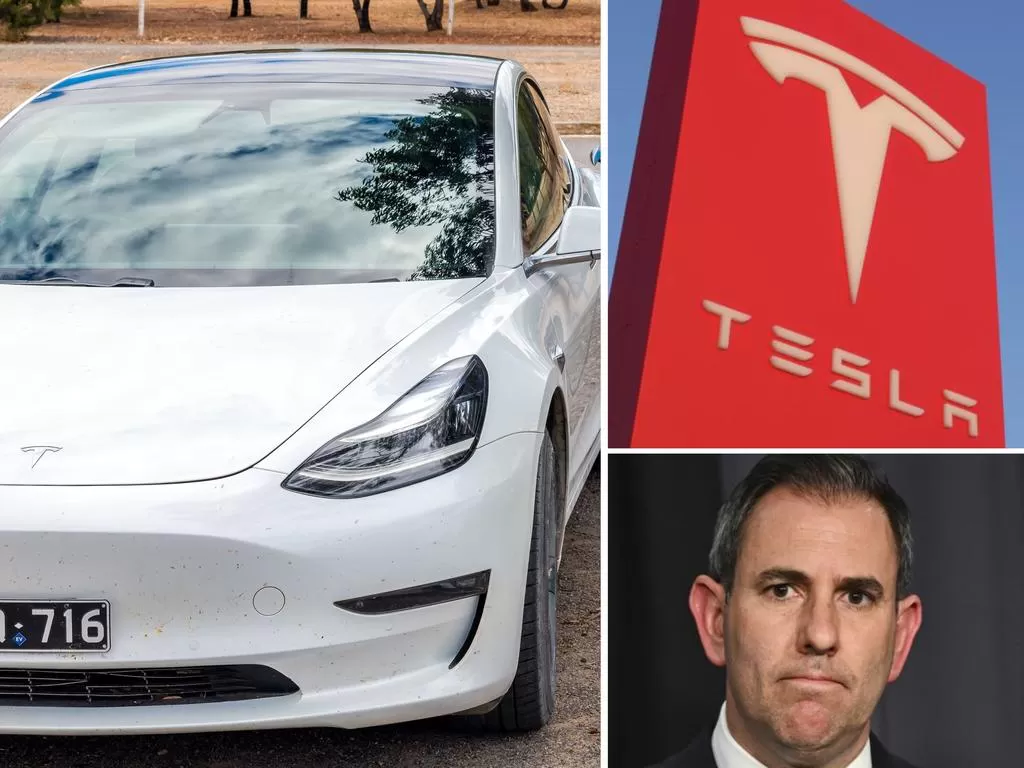
Treasurer Jim Chalmers has emerged from his three-day economic roundtable with “10 clear areas” for reform and consensus on a new regime of road user charges to replace petrol excise.
Wrapping up the talks in Canberra on Thursday night, the Treasurer confirmed that he will hold further talks with the states on September 5.
Based on a planned NSW road user scheme, a national rollout will depend on your mileage but might cost between $300 and $400 a year.
But there’s no clear guidance yet on how much the new tax will cost, whether it will entirely replace petrol excise over time or when it will apply to EV cars and hybrids.
The Treasurer also talked up reforms to harness the power of artificial intelligence, slashing red tape to build more new houses, abolishing nuisance tariffs, establishing a single national market and tax reform.
“There was a lot of support in the room for road user charging,‘’ the Treasurer said on Thursday night.
“There wasn’t a final model settled, but there was a lot of conceptual support for road user charging.”
“There was more than the usual amount of consensus in a conceptual way around road user charging. A lot of reform appetite in that area, which is welcome.
“The states are putting together an options paper and to give you a sense of the considerations that people in the room were grappling with.
“Right around the table people had a view that this is an idea whose time has come and so we will do that work.”
Get all the latest Australian news as it happens — download the news.com.au app direct to your phone.

Tax reform
On tax, the Treasurer said that participants had “a few hours of very welcome conversation and debate about the future of the tax system”.
He said that there was support to address three objectives in the tax system.
“The first one is about a fair go for working people and including in intergenerational equity terms,” he said.
“That’s the first category. The second one was about an affordable, responsible way to incentivise business investment, recognising the capital deepening challenge that we have in the economy and what that means for productivity and for growth.
“And then thirdly, how we make the system simpler, more sustainable so that we can fund the services that people need, particularly in the context of the big shifts in our community, including ageing and other pressures as well.
How EV tax could be rolled out
Treasurer Chalmers said he would now hold further talks with state and territory treasurers on September 5.
News.com.au reported earlier this month that Australia’s new tax on electric vehicle drivers is set to kick off with a trial period for trucks before it stings cars.
The Albanese Government is looking at a staged rollout to test the proposed new EV tax and trucks will be the first cab off the rank.
It is also interested in a new road user charge that sends price signals on the best time to be on the road, or the freeway.
Over time, it could replace petrol taxes and apply to all cars based on distance travelled and when cars and trucks are on the road to tackle congestion.

Free ride for EVs nearly over
The free ride enjoyed by drivers of electric vehicles is coming to a close with Treasurer Chalmers and state governments finalising plans for a new road-user charge.
All Australian motorists who buy petrol and diesel at the bowser pay 51.6 cents a litre in fuel excise. But drivers of EV vehicles pay nothing.
“The status quo won’t be sustainable over the next decade or two,’’ Treasurer Jim Chalmers told news.com.au.
“As more and more people get off petrol cars and into EVs we’ve got to make sure that the tax arrangements support investment in roads.
“But we’re in no rush, changes of this nature will be made, because the status quo won’t work in 10 or 20 years.”
The Treasurer made no secret of his support for a road user charge before the election, but favours a staged rollout of the changes.
Victorian Treasurer Tim Pallas said that electric vehicles are “heavier and do more damage to the road network as a consequence than do internal combustion engine vehicles”.
“By giving drivers a clear signal about the cost of infrastructure, they would have an incentive to use it more efficiently,” the Productivity Commission report said.

How does fuel excise work?
The current rate of fuel excise is 51.6 cents in excise for every litre of fuel purchased.
For a typical household with a car running on petrol, the tax costs more than $1200 a year.
But the flat sales tax isn’t paid by drivers of pure electric vehicles, who simply need to plug in their cars to recharge.
While registration and driver’s licence fees go to state and territory governments, fuel excise is collected by the federal government.
Australian motorists paid an estimated $15.71 billion in net fuel excise in 2023-24, and are expected to pay $67.6 billion over the four years to 2026-27.
However, governments have long-warned that a road-user charge will be required to fill the gap in the budget left by declining revenue from the fuel excise, as the petrol and diesel engines in new cars consume less fuel and Australians adopt hybrid and electric cars.
What does the AAA say?
The Australian Automobile Association (AAA) is calling for a national approach to road-user charging but wants a guarantee the revenue will be earmarked for road upgrades.
The AAA backs a distance-based road-user charging as a fairer and more equitable way to fund land transport infrastructure.
The 2024 federal budget forecasted a reduction in fuel excise receipts by $470 million over four years from 2024-25.
Roadblocks to reform
Currently, New South Wales is the only state with firm plans to introduce a road-user charge from 2027 or when EVs reach 30 per cent of new car sales.
Plug-in hybrid EVs will be charged a fixed 80 per cent proportion of the full road-user charge to reflect their vehicle type.
Western Australia has also stated an intention to implement a road-user charge.
Meanwhile, Victoria’s electric vehicle levy had to be scrapped following a ruling from the High Court.
Two Victorian electric car owners launched a legal challenge on the basis the tax was not legal as it was an excise that only a federal government could impose.


They won, with the High Court upholding the legal challenge.
There have been several false starts to enshrine a road-user charge including in South Australia, where the former Liberal Government planned to introduce a charge for plug-in electric and other zero emission vehicles, which included a fixed component and a variable charge based on distance travelled.
It was later pushed back to 2027 due to a backlash before the legislation was ultimately repealed.